
The year was 2006, and I was deciding between two universities which had accepted me. Washington State University (WSU) was on the eastern border of the state, in the sleepy town of Pullman. It was one of the two big state universities (the other being the University of Washington, which had rejected me for lack of foreign language credits). The other was Central Washington University (CWU), a regional liberal arts college with a stellar music program and a fascinating honors curriculum. By the time I was finishing up high school, my GPA had recovered from a faltering start and failing Freshman year Algebra. I had taken an AP literature course my senior year which functioned as a colloquium. We’d all write five paragraph essays each week and discuss them in class after reading the text of the week. It was a grueling course, but it had prepared me for doing even more rigorous work in college. I had submitted an essay to the honors college at Central, and to my delighted surprise, was accepted.
I visited both campuses and chatted with a lot of grown-ups (I hate to break it to you, but while you may be an adult at age 18, you certainly are not “grown up”) about where I should go. Oma and Papa wanted me to pursue a music education degree, as it had been your Papa’s dream when he was younger. Unfortunately his dad had died around the time he graduated high school, and his mom (whom was actually his grandmother, but raised him) needed help at home. So he never got to go to school. Both WSU and CWU had good music programs, but Central had the edge there. And there was the question of this honors program, which was rather unique, and WSU had no analogous program. Because of that, I resolved to attend Central, even though it was less prestigious on paper.
The Douglas Honors College (DHC) at CWU was modeled on the Great Books curriculum which had been developed at Columbia University during the 1920s. That program, in turn, was modeled on the Classical education which students had been receiving in one form or another since antiquity. Early 20th Century Great Books programs focused heavily on Western philosophy and traditions, and required students to read, analyze, and discuss primary texts in a wide variety of fields. They weren’t supposed to teach technical or job-related skills so much as to teach the humanities — those subjects which make us whole human beings. Aside from the obvious “How will this make me money?” criticism, another critique of these programs was that they operated largely to the exclusion of non-Western perspectives. Both of these criticisms led Great Books programs to wane through the late 20th Century, and by the beginning of the 21st Century, they had almost become extinct. The DHC was one of the few remaining programs left, and I wanted desperately to continue the Classical education I had received in that AP literature course.
I will say that the DHC had addressed the second criticism quite directly. Their curriculum incorporated a lot of Eastern philosophy and literature, and was fleshed out with guest speakers and cultural events each term. Many of the stories you’ll read in this book relate to those speakers and events, and they wound up being major formative experiences in my life. I’m including a copy of said curriculum in the proceeding pages, in hopes that you’ll choose to adopt it for your own education. I encourage you to share it with friends and start a book club. Read one work every week or two, and do some outside research using secondary sources to better your understanding after you’ve read it. Then, draft short essays (3-5 pages) about the work, and exchange them amongst yourselves. Finally, having read each other’s essays, get together and discuss. You’ll find that your academic horizons will be broadened by the variety of perspectives that you’ll be exposed to in this manner.
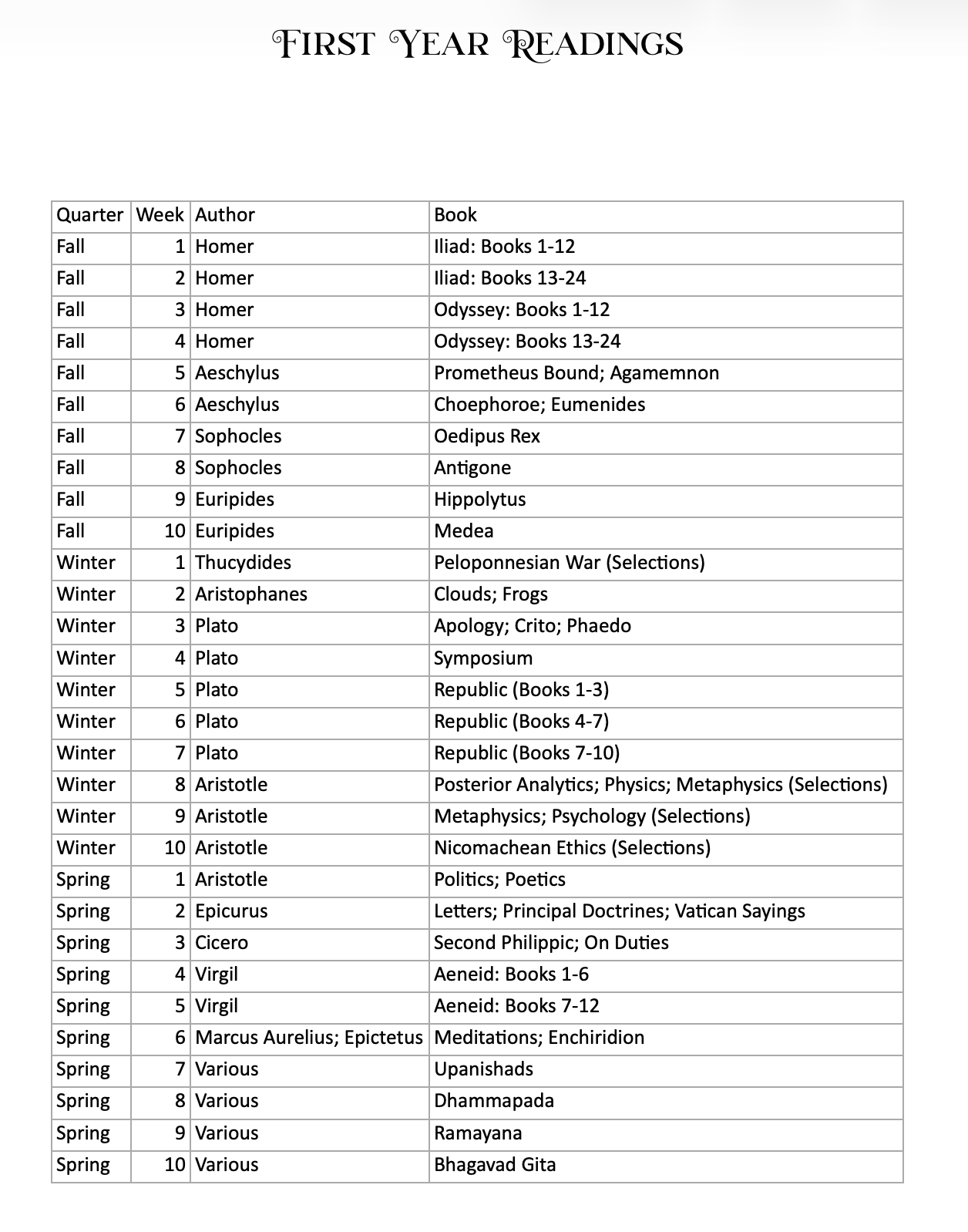

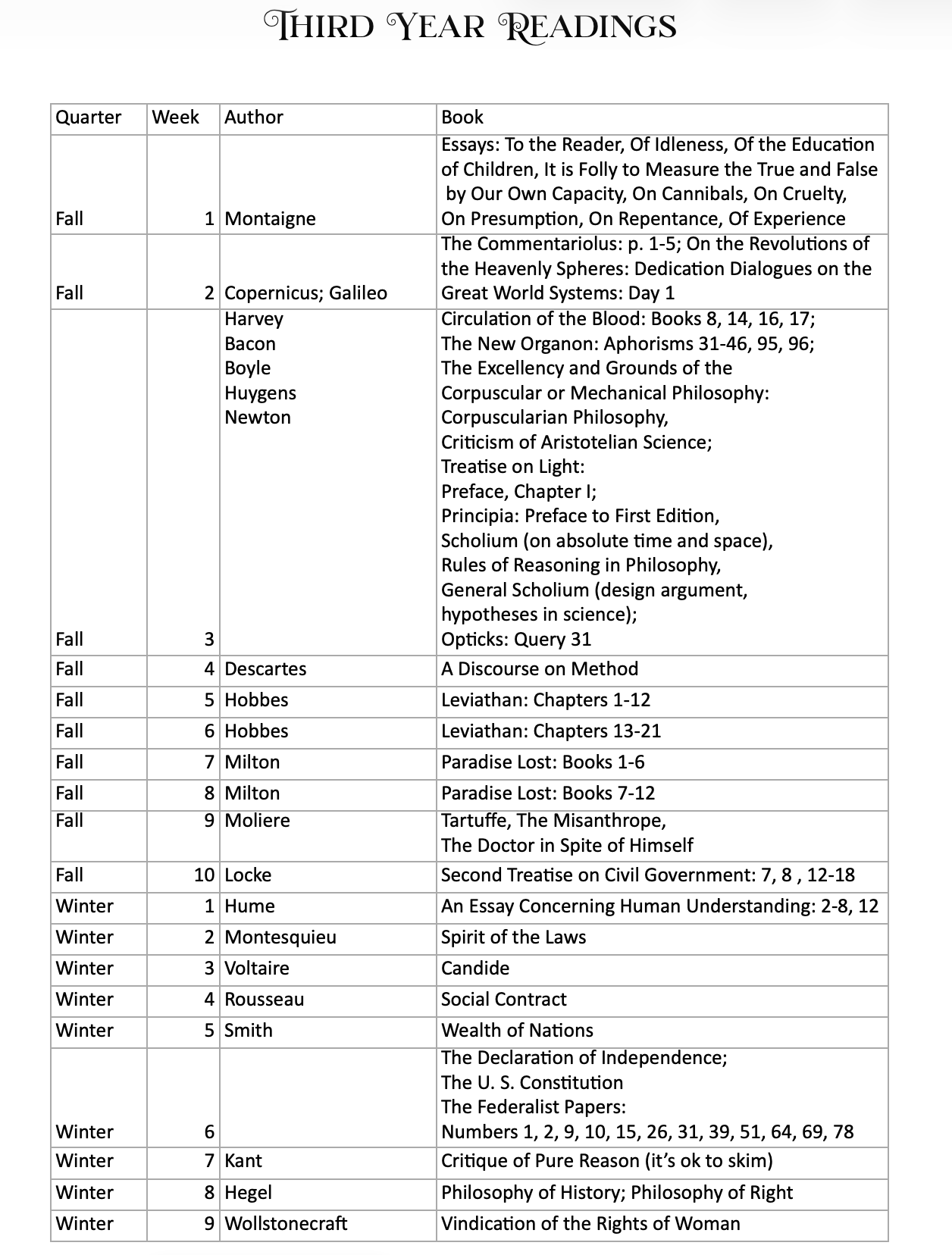
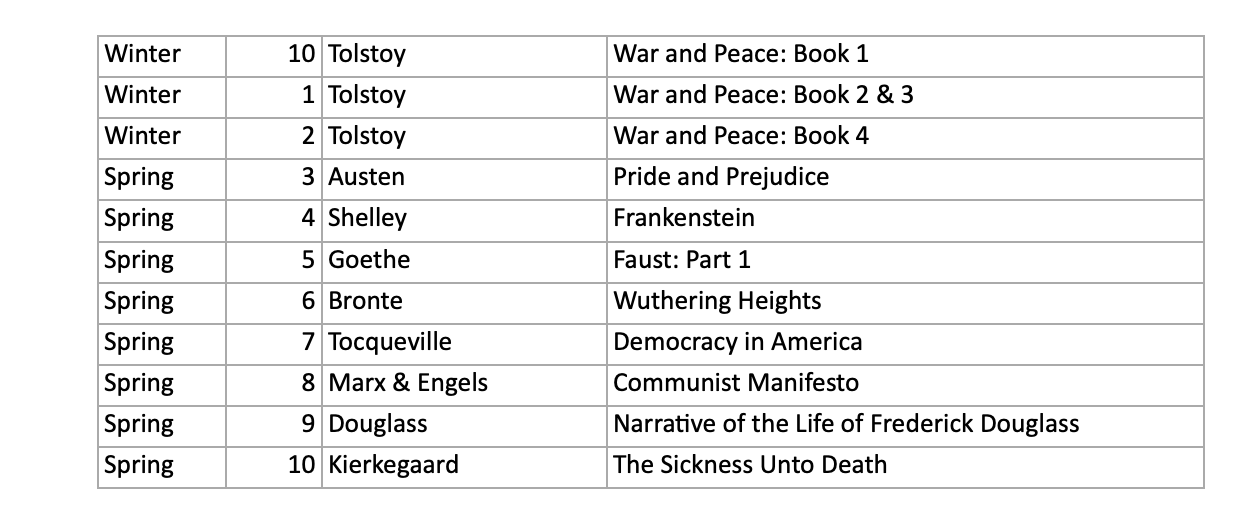
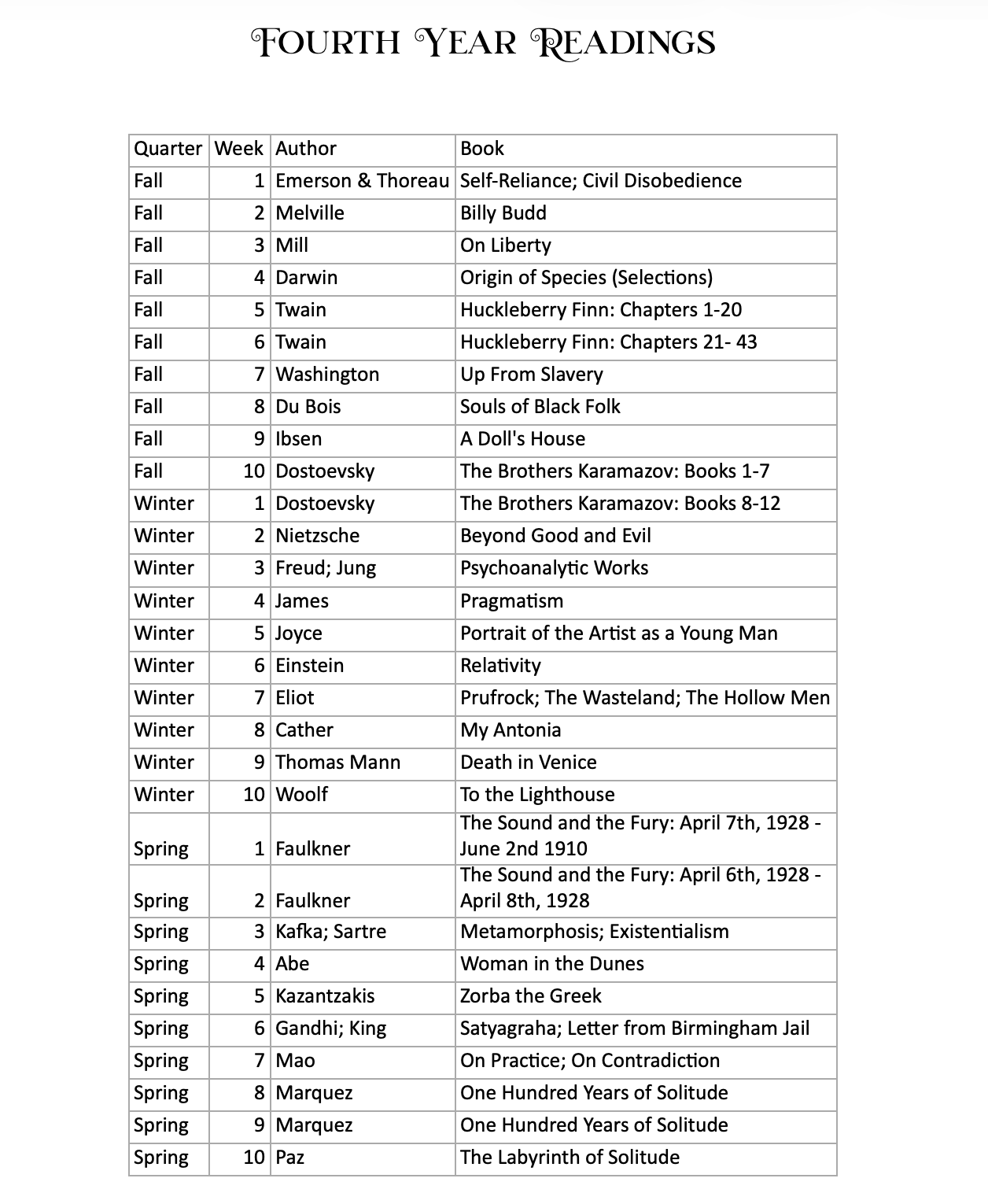
As you may see, dear daughter, this list is comprehensive. You don’t have to follow the strict schedule that I did. Take your time. Savor these works, but please make forward progress. If you’re able to finish even a quarter of this list, you will be more educated than 95% of your peers. But again, I encourage you to bring them along with you on this journey. Start a book club. Reach out to local professors of Classics, and see if they’d be willing to moderate your discussion group. Better yet — go to University, and study this shit. It will enrich your life, and make for a more holistic experience, far beyond that which others will have.
I mentioned earlier that many of the stories in this tome come from my experiences in the DHC. What I haven’t mentioned is that the writing skills I developed — drafting a five page essay on an obtuse text every week for four years straight — are the reason I was able to draft this memoir for you at all. Learning to think, to read, to analyze, to impart your own experience upon the text, and then to synthesize that and put it on a page… that is not a trivial task. It takes time, effort, and conviction in the notion that you are good enough, smart enough, diligent enough, and worthy enough to hold the vast summation of human knowledge in your mind. Not many hold that level of self-esteem, but I certainly hope that you’ve been imparted with that throughout your childhood. Go forth, discipula, and make due haste to fill your mind with the myriad treasures laid before you. May you go in peace, and carry the light of knowledge with you.