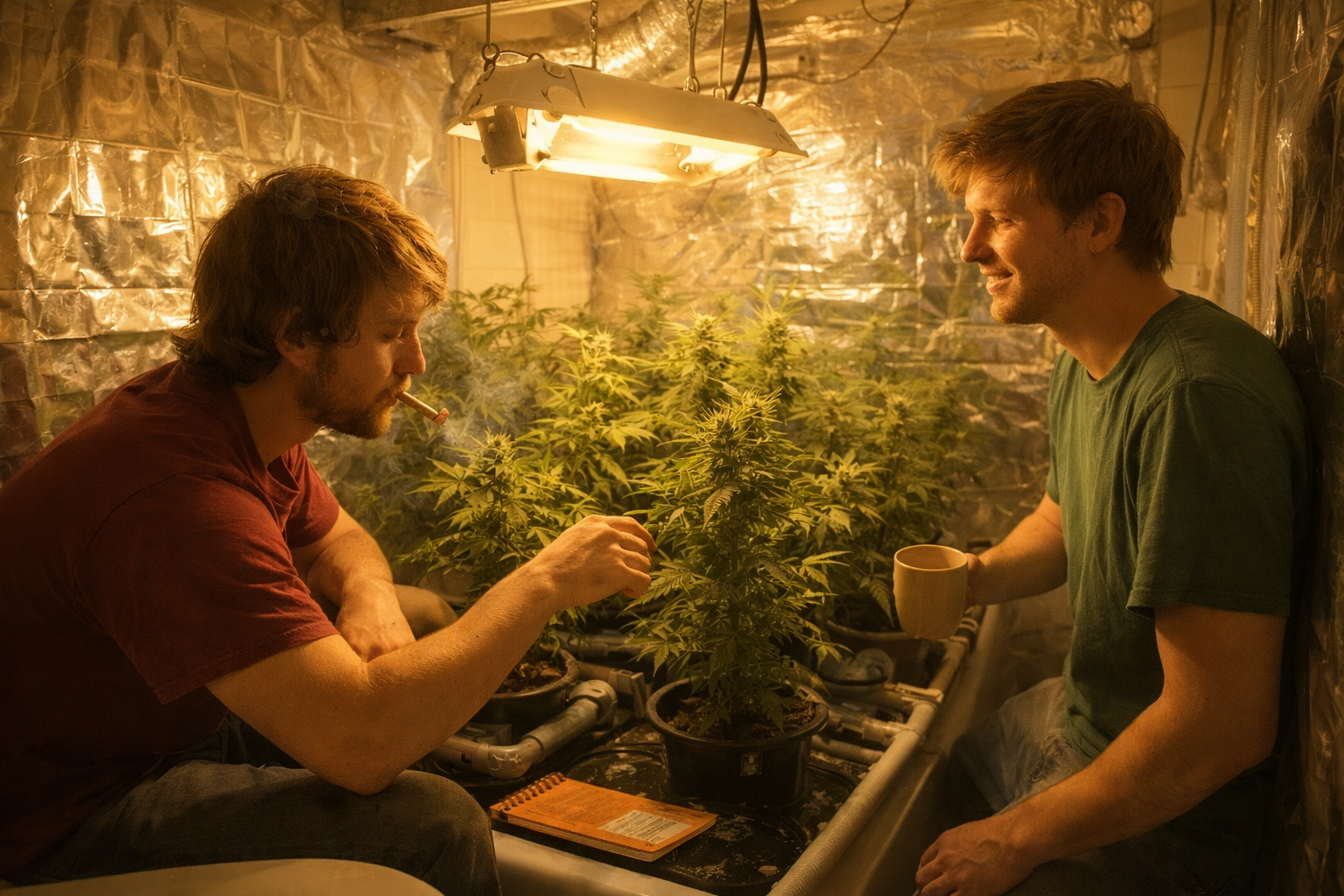
I graduated from Central Washington University in the Spring of 2010. It was the tail-end of the Great Recession, and there were a lot of opportunities out there — for people who didn’t have a degree in philosophy. I didn’t regret my decision to pursue the love of sophistry, though, as I believed then (as I do now) that it made me a more whole, more authentic, overall better person. That being said, I had to earn a living somehow.
As a matter of fortune or misfortune (depending upon who’s point of view you were considering), my friend Luke had dropped out from Central at the same time I had graduated. He had always been a bright kid, but didn’t have the chops for college. He had started early, at seventeen, and wasn’t really prepared for the experience. It didn’t help that I had introduced him to the pleasures of the mind, training him as an avid professional psychonaut during our time in school together. We tripped on acid for the first time together, experienced salvia together a handful of times, and of course I had introduced him to weed and alcohol. I fit the role I had chosen as a philosopher — a corrupter of the youth — and took to the task with aplomb.
That all being said, he also had to make a living, and we both needed a place to stay. So I decided to do the only reasonable thing a broke philosopher with no real marketable skills could do at the time — I opened up a medical marijuana operation and took Luke on as a business partner and roommate. You see, our state had recently passed RCW 69.51, which allowed cultivation of medicinal cannabis under certain circumstances. One of those circumstances was that you obtain a doctor’s recommendation to use cannabis for the treatment of one of your health conditions. I had a history of tachycardia (which I later discovered was caused by panic attacks), and Dr. Said had decided to give me my recommendation.
Dr. Said was a very interesting figure. He was a bit eccentric, and had run for U.S. Senate once or twice (without much success). I walked into his office and shared my health issues, and how cannabis had been able to put me into a calm state where my heart wouldn’t be racing. He agreed that cannabis would be a good course of treatment, as it had a track record of success, and I got my medical card (which I still carry with me, along with all of my other identifying and licensure documents). With this card, I could grow up to fifteen plants for myself and other patients, and distribute to other patients in my collective without risk of penalty.
I then proceeded to compile a list of every single apartment complex in the Tri-Cities area (where we planned to move). I personally called each manager of every complex, and offered to provide a free training on the new medical marijuana law. I would drive around and give the presentation to each of them, and then I’d ask a few questions — whether they would be ok with residents using edible cannabis, whether they would allow smoking of cannabis in their apartments, and whether they would allow patients to grow their own supply in their apartments. I had three reasons for doing this. First, I wanted to improve public education on the new law, as it was a bit complicated, and I figured it would benefit a lot of people by destigmatizing medical cannabis use. Second, I wanted to have a list of apartments that my eventual clients would be able to move into without fear. Third — I needed a place to live which would allow me to grow and distribute cannabis to my clients.
I found one manager who would allow all three things, and decided to move in there. Luke and I didn’t have many personal belongings, so the move-in process happened pretty quickly. The apartment was unremarkable, three beds, two baths, second floor. There was a pool outside I never used. We threw a TV in the living room, which was primarily used to watch episodes of “Star Trek: Voyager” until the wee hours of the morning while getting really, really baked.
We wound up using one of the bathrooms for our grow effort. The particular strain we decided to go with was an auto-flowering variety of Jack Herrer, which would serve well for pain relief and inducing pleasant, restful sleep. The advantage of auto-flowering strains is that unlike traditional strains, these mature in approximately three months instead of six. This time efficiency was essential in our situation, as we needed to earn money quickly in order to cover ongoing rent and living expenses. We covered the walls with mylar, and had purchased a hydroponic growing system — fifteen pots, plumbing, a fifty gallon water reservoir, and a water pump on a timer. Our lighting setup was traditional for the time (this was before the age of LED growing, so our electricity bill was perpetually high) a metal halide lamp for vegetation stage running on a 12/12 cycle, and a high pressure sodium lamp during flowering running on an 8/16 cycle. Having prepared our workplace, we hunkered in for the hot, dry Tri-Cities summer.
My days became a strange sort of routine — pack product for the appointments of the day, drive around town making deliveries, taking tokes with patients along the way (which, by the way, I do not recommend — don’t smoke and drive, even if it’s just one hit), and generally having a good time. Luke tended to the plants, conducted business meetings with our third business partner (whom we were working with for distribution and clone procurement), and lounging around the house. He didn’t drive, and didn’t have any luck finding a side job that summer (neither did I, for that matter), so this arrangement worked for us.
That first summer month, I received letters back from all three law schools I had chosen to apply to. George Mason University denied my application outright. In hindsight, getting rejected from there was probably a good thing, given that they chose to rename their school in honor of the late Justice Antonin Scalia after he passed, making their name the Antonin Scalia School of Law (or ASSOL, pronounced “asshole”) — they decided to change that slightly a few months later. Regardless, I’d rather not have a reference to Scalia on my resume. I was also rejected from Willian and Mary in Georgetown. That was a bit disappointing in the moment, because I would have been able to study Constitutional Law in great detail there, and perhaps get a clerkship which would allow me to use those skills. The third school I applied to was Drexel University, which sent a letter informing me that I had been put on the wait list.
I was, predictably, disappointed. I had no other plans outside of growing weed for a living, and while it was admittedly a noble pursuit, I had always hoped to be able to get a doctoral degree to compete with my step brother, your uncle Adam, whom had attained an MD. That being said, I resigned myself to the reality of my situation, and tried to make the best out of what I had — a bachelor’s degree in Philosophy, a minor in classics (both with honors), and a lot of gumption. I redoubled the efforts on our business, and managed to garner an extremely loyal and frequent book of clients. Things, by-and-large, were good.
I’ll take just a moment to explain why I applied to Drexel. It was a new law school, only a few years old, and had yet to be ranked by US News and World Reports. Drexel prided itself on vocational learning, promising cooperative and externship placements to their students. You would work for a full year with one of their local partners getting on-the-ground experience in your chosen career, and a resume item to go along with it. I quite liked that idea, having run my own MSP for a decade prior, and I fancied the idea of one day owning my own firm. More importantly though, Drexel had won Students for Liberty’s “Club of the Year” the year prior. Students for Liberty was essentially an anarcho-libertarian group that networked extensively with “The Movement(TM).” I, being a fedora-laden edgelord at the time, thought that a lovely opportunity to network with like-minded minds. So, I was quite elated when, seven days before the start of the new term, I received another letter from them indicating that a spot had opened up for me. I would indeed earn my doctoral degree, become a lawyer, and do something more with my life than help terminally ill cancer patients be freed of pain. I would be important…
…
There’s one element of this story that I have omitted up until this point. There was a girl who I had been dating throughout our senior year of college. She was young, pretty, and smart — but a little bit quiet (much like your mother). We had a long distance relationship over that summer, as she lived in Yakima, a bit over an hour away. I visited her once that summer, and we chatted on occasion. By this point, it was clear the relationship couldn’t continue. As soon as I landed in Philadelphia, I called her and told her I got into law school, and that we were through. As I walked down Broad Street that first night in a new city, a black Mercedes rolled past, slowed down, and the window rolled down. A Black man in a fancy hat yelled out at me “Hey! Nice ass!” I shouted back, “Thanks!” He drove off, and I never saw him again.